Table Of Content
If traffic slows to a stop, most ACC systems will bring the car to a complete stop, then bring it back up to speed when traffic gets going again. Others work only within certain speeds and/or might not start to accelerate automatically. The driver can use the touchscreen to steplessly swivel and zoom the image of the car and the actual vehicle surroundings. There is also a view of the front or rear tires so that the driver can pull the car up right next to the curb.
Traffic jam assist
In addition, the system activates the hazard warning lights to alert following traffic to the critical situation. In this process, the Rear-end collision alert signal (RECAS) is triggered, which flashes the hazard warning lights at a high frequency. Audi pre sense rear is active in background over the car’s entire driving speed range with the exception of trailer towing situations. The adaptive cruise assist (ACA) assists the driver with longitudinal and lateral control over the entire speed range – substantially enhancing comfort on long journeys, in particular. It incorporates the functions of adaptive cruise control, traffic jam assist and active lane assist.
Central driver assistance controller
The reversing camera simplifies maneuvering by showing the zone behind the vehicle on the MMI display. It shows the calculated driving track based on the steering angle as well as auxiliary lines and guide lines. For parallel parking, the latter lines precisely direct steering into the parking space in conjunction with steering reversal points. The blue pictured surface in the camera image indicates where the vehicle will be positioned after the parking procedure. The reversing camera is inconspicuously integrated into the handle trim strip of the luggage compartment lid. It is activated as soon as the driver engages reverse gear or pushes the respective button.

adaptive cruise control with stop & go function
The system keeps the distance to the car in front constant by automatically braking and accelerating. In conjunction with S-tronic or tiptronic, the Stop & Go Function allows independent braking to a standstill and automated restarting at the driver's request. Adaptive cruise control maintains a desired driving speed constantly.
Trailer maneuver assist
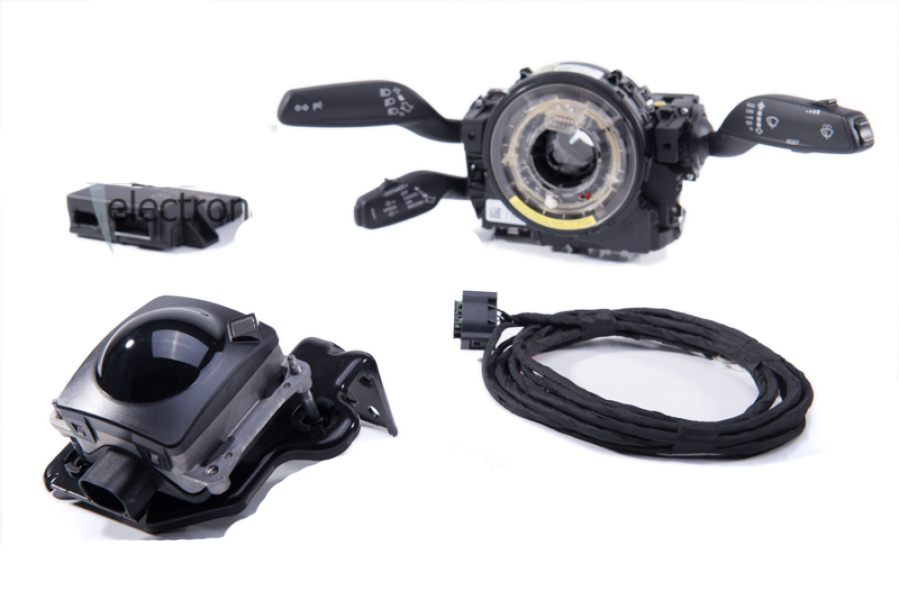
The ACC stop & go uses two radar sensors installed at the front of the vehicle which are automatically heated when it is cold. They transmit radar waves at a frequency of 76.5 gigahertz covering a roughly 40 degree wedge-shaped field measuring approx. The driver can influence the function of the ACC stop & go; the interval to the vehicle ahead and the control system dynamics are adjustable in steps. The system accelerates smoothly or sharply, depending on the setting. Deceleration is limited to roughly 4 m/s2 (13.12 ft/s²), which is a good third of what is possible.
The New Audi A3 Is Amess With In-Car Subscriptions [Update] - Motor1
The New Audi A3 Is Amess With In-Car Subscriptions [Update].
Posted: Wed, 13 Mar 2024 07:00:00 GMT [source]
Developers can replace individual sensors whenever better devices are market-ready. Driver Assistance features are not substitutes for attentive driving. Please see your owner’s manual for further details and important limitations. According to Greg Migliore of Autoblog, “Automakers have been insisting for years that the autonomous technology is virtually ready, they just need the infrastructure and laws to catch up.
Easiest way to compare and buy car insurance
The highly intelligent ACC system utilises data from other driver information systems to continuously analyse the vehicle’s surroundings. It’s able to recognise intricate scenarios and predictively support the driver with reflection and composure. A safety measure is included, alerting the driver when a collision is imminent, tightening seat belts and priming air bags in preparation.

High-beam assist
If the car approaches a line without the turn signal being activated, the system helps the driver to steer back into the lane by means of gentle but noticeable interventions in the electromechanical power steering. In the MMI system, the driver sets how early the control intervention should occur. In the case of an early steering intervention point, the system guides the driver towards the middle of the lane by gentle, centering steering interventions. In addition, the driver may choose to be warned by a vibration of the steering wheel when crossing detected lane markings. Parking system plus informs the driver, visually and audibly, about obstacles in front of and behind the vehicle. Ultrasonic sensors inconspicuously integrated into the bumpers measure the distance.
CR Rates Active Driving Assistance Systems - Consumer Reports
CR Rates Active Driving Assistance Systems.
Posted: Tue, 17 Oct 2023 07:00:00 GMT [source]
It does this by using the radars in your car to detect the vehicle in front of you, and depending on what it does, it will either accelerate or decelerate your vehicle up to a maximum speed that you can specify. The sensor data is read into the “fusion” layer in the zFAS unit and is merged to generate a sophisticated model of the surroundings. The latter is generated from the conventional navigation map and from road markings and borders that the sensors detect. The vehicle is guided precisely within its lane in the model, and this positional information flows into the navigation map that the driver sees. This information offers the driver many benefits, such as in complex intersection situations.
If the driver so wishes, the system controls the freewheeling and coasting operation of the engine in cooperation with other control units. The predictive system always maintains a driving style that reflects the driving program selected – from efficient to sporty – and uses scope for recuperation in the Audi e-tron. Audi pre sense basic initiates preventive safety measures for occupants as soon as it recognizes a critical driving state. It utilizes information from various vehicle systems to determine this. For instance, it intervenes if the Electronic Stabilization Control (ESC) sensors detect skidding or hard braking. Then the system pretensions the seat belts of the driver and front passenger electrically to reduce their forward or lateral movements.
This expanse of knowledge enables the system to recognize complex scenarios and predictively support the driver. Because it also cooperates with the navigation system, it knows the course of the selected route in advance and can also compute the lane in curves, for example. The ACC stop & go uses its networked knowledge in numerous situations. Audi offers the adaptive cruise control in a number of different versions, with and without stop & go function, depending on the model series. The function of the individual versions varies slightly due to the different degrees of networking and the expansion levels.
This sends the images from the 360 degree cameras to the MMI monitor. They drastically expand the field of view, and the driver can choose from among multiple views. The figures do not refer to a single, specific vehicle and are not part of the offering but are instead provided solely to allow comparisons of the different vehicle types. Collision avoidance assist helps the driver steer around an obstacle in a critical situation. The system uses data from the two radar sensors and the front camera for this purpose.
However, the driver can temporarily override the limit by kick-down, and the speed limiter can be completely deactivated at any time from the steering column stalk. Ultrasonic sensors measure the distance, the MMI display depicts it visually. The virtual driving path display also shows lateral guide lines which are precalculated based on the currently selected steering input.
Stop-and-go adaptive cruise control makes it easier to accelerate, decelerate, and maintain distance and speed. Radar, camera, laser scanner, and ultrasonic sensors are used by adaptive cruise assist to continuously monitor the environment and support highway driving. The zFAS serves as the central interface for piloted driving functions and for nearly all of the assistance systems. Whether the given system is the crossing assist, the emergency braking function, adaptive driving assistant or traffic jam pilot – its functions are no longer coupled to just a specific sensor. Each system makes use of the vehicle surroundings model and can operate more effectively as a result of this model’s high precision. This makes it possible for the vehicle, for example, to recognize the tail end of a traffic jam and brake appropriately.


No comments:
Post a Comment